“Life is like a voyage on the sea of history, often dark and stormy, a voyage in which we watch for the stars that indicate the route. The true stars of our life are the people who have lived good lives. They are lights of hope. …Jesus Christ is the true light, the sun that has risen above all the shadows of history. But to reach him we also need lights close by—people who shine with his light and so guide us along our way.”
― Pope Benedict XVI, Spe salvi
This past Saturday the Church celebrated the Solemnity of All Saints. This great feast calls us to meditate upon what the Apostle St. Paul called the “cloud of witnesses” — those countless souls who have gone before us, witnessing in both ordinary and extraordinary ways to the truth and power of the Gospel.
Often when we hear the word “saint,” our thoughts immediately go to some of those towering figures of Church history: St. Paul, St. Augustine, St. Francis, St. Teresa of Avila, Pope St. John Paul II, etc. And indeed, on All Saints we should call to mind those saints for whom we have a particular devotion, and to ask for their support and guidance.
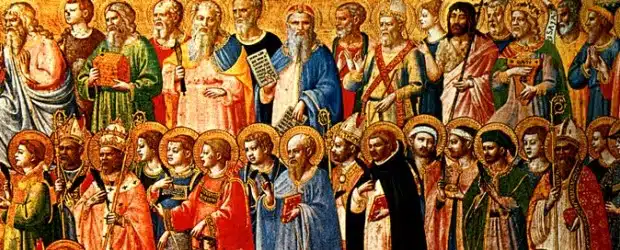
However, on this day, I also like to think of the many hundreds, or perhaps thousands, of ordinary pro-life and pro-family activists and supporters who I have personally known over the decades. I am convinced that many of them, who lived saintly lives and faithfully served the Gospel of Life, now experience the reward of eternal life. How many such ordinary saints there are, I will never know, at least not in this life.
But how else am I to think about the steadfast courage of those souls who poured themselves out in defense of the dignity of human life and the family, standing as bulwarks against the threatening tide of the culture of death? Many of these men and women are unknown to all except a handful of people, and their acts of sacrifice and heroism often known only to themselves, or perhaps a handful of those closest to them.
Ordinary People Living Extraordinary Holiness
I think of the prayer warriors who showed up outside the local abortion facility week after week, in rain, sleet, snow, or hail, to minister to women in crisis pregnancies. There they quietly offered real compassion and real support, helping women avoid making one of the worst mistakes of their lives. And they often did so in the face of jeers and abuse from abortion facility escorts, or passersby.
I think, too, of the numerous volunteers who have manned the thousands of pregnancy care centers spread across our nation (and world), offering a safe haven for women who need a loving space in which to think, far from the pressures that are pushing them towards abortion. Not only have many of these people given generously of their time, but also often of their treasure, providing the funds needed to buy the buildings and supplies required for the ministry.

I think of the mothers and fathers who welcomed new life into their home, and then in a million hidden ways showed their children that they are loved unconditionally, with a Christ-like love. And in so doing, they raised the next generation of hidden saints, those who will act as the “salt of the earth,” giving flavor to our often-insipid age through their compassion, kindness, and Christ-like love.
I think, too, about the many parish priests and bishops who quietly, steadfastly continued to preach the Gospel of Life, even in the face of enormous pressure from wayward parishioners, activists, and the media to compromise…or else.
Building a Culture of Life Through The Little Way
This, in part, is the great power of this Solemnity of All Saints. It provides a moment to pause and reflect on the reality that the definition of a saint does not apply only to those who have accomplished “great” works for the Church. As St. Thérèse of Lisieux so tenderly told her readers, what matters most is not so much great deeds, but the love with which our deeds, even the humblest, are done.
When you apply this definition of sanctity, then it becomes apparent that the ranks of the blessed must be significant indeed. In my decades of work within the pro-life and pro-family movement, I have seen more such deeds of love than I can count. It is the multitude of such hidden deeds that, I am convinced, stands against the tide of hatred, violence, and death that would otherwise overwhelm our civilization.

Too often we give our attention solely to our politicians, celebrities, and business leaders, forgetting the strength of a civilization is found at the level of the foundation, i.e. of individuals and the family. The lives of all saints affirm and promote the first principle of Catholic Social Teaching, i.e. the intrinsic dignity of the human person. And it is this, not great power or wealth or talent, that creates a just and humane society.
This principle affirms that every person is made in the image and likeness of God—endowed with an intrinsic worth that no power, no law, and no circumstance can erase. As the Compendium of the Social Doctrine of the Church [1] reminds us, “A just society can become a reality only when it is based on the respect of the transcendent dignity of the human person” (no. 132).
Every saint, in his or her own way, defended the truth that human life is sacred. Some did so by preaching and teaching, others by acts of service or mercy, and still others by suffering injustice with faith and love. In their witness, we see the light of Christ overcoming the darkness of every age.
Saints Who Stood for Human Dignity
When, however, we turn our attention away from the hidden “cloud of witnesses” that I have been speaking about and look at those whom the Church has formally raised for emulation through canonization, one is struck by the embarrassment of riches available to us.
Consider the example of a young Jesuit named Peter Claver, who dedicated his life to enslaved Africans who arrived in chains aboard Spanish ships in modern-day Colombia. Known as the “Slave of the Slaves,” St. Peter Claver met the captives at the docks, tended to their wounds, and baptized tens of thousands of them. In an age when slavery was accepted and even justified, including (tragically) some within the Church, his work was a radical act of love and justice. He proclaimed through his actions that no human being could ever be treated as property.
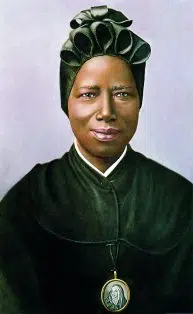
Another powerful witness is St. Josephine Bakhita, who was born in Sudan around 1869 and kidnapped as a child by slave traders. She endured beatings, humiliation, and unspeakable suffering. Yet when she later discovered the love of Christ and gained her freedom, she chose forgiveness over hatred. She entered religious life as a Canossian sister and dedicated her life to service.
Then there is St. Damien of Molokai, the Belgian priest who gave his life serving those afflicted with leprosy in Hawaii. Where others saw outcasts to be avoided, Damien saw brothers and sisters to be loved. He lived among them, cared for their wounds, built homes and churches, and eventually died of the disease himself. In an age when society often hides away those who suffer—the homeless, the addicted, the mentally ill, the terminally sick—St. Damien’s life challenges us to recognize Christ in every human face.
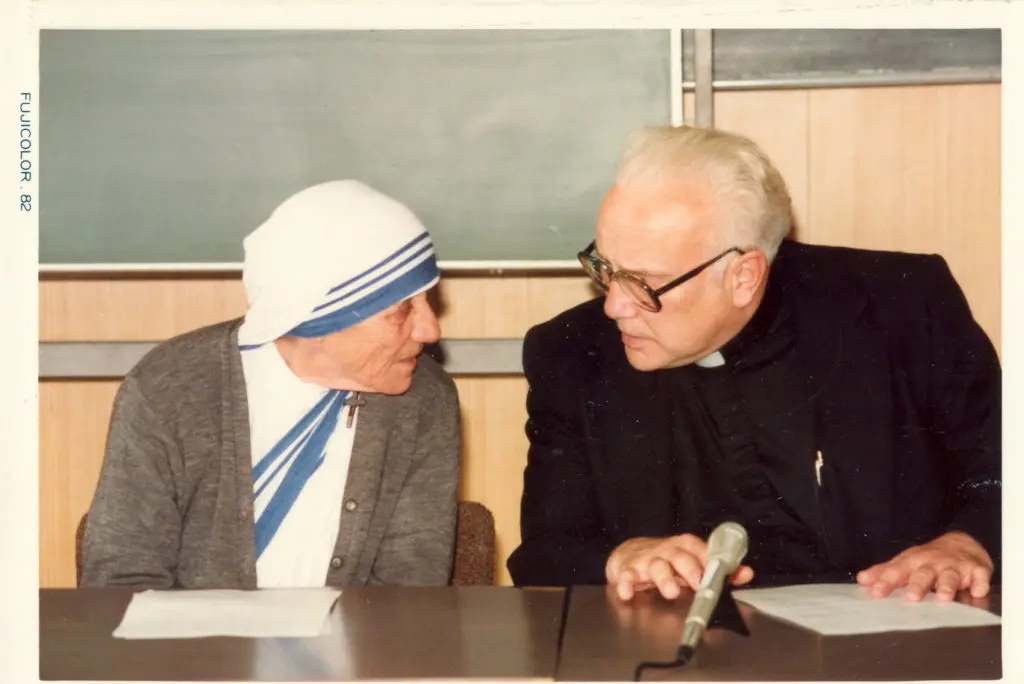
Few modern figures embodied the Gospel of Life more visibly than St. Teresa of Calcutta. Her mission was simple yet profound: to serve “the poorest of the poor,” seeing in each one “Jesus in distressing disguise.” She treated the forgotten dying not as statistics, but as Christ Himself. “The biggest disease today,” she once said, “is not leprosy or tuberculosis, but the feeling of being unwanted” (A Simple Path). Her life teaches us that the defense of human dignity begins not with policy but with vision—the ability to truly see the person before us as someone made in God’s image.
And who can forget the incredible example of St. Maximilian Kolbe, who brought Christ’s love even into the heart of darkness itself, i.e. the Nazi concentration camp Auschwitz? When a fellow prisoner was condemned to die, Kolbe stepped forward and offered his own life in the man’s place. “I am a Catholic priest; let me take his place,” he said simply. Even in a place built to annihilate human dignity, he proved that love is stronger than hatred and that the image of God in man cannot be destroyed.
Pope St. John Paul II, who canonized Kolbe and Bakhita, became one of the greatest champions of human dignity in modern history. Having endured both Nazi occupation and Communist tyranny, he understood the consequences of ideologies that deny the worth of the person. In his encyclical Evangelium vitae [2], he called the world to reject the “culture of death” and build instead a “culture of life.” His message was deeply theological: every person, from conception to natural death, reflects the image of God.
You Are Called To Be a Saint
In our own time, the assaults on human dignity are many: abortion, euthanasia, pornography, human trafficking, war, and the pervasive “throwaway culture” that discards the weak, the poor, and the preborn. These are not merely political or social issues; they are spiritual crises. They are signs of a world that has forgotten that human beings are not things to be used, but persons to be loved.
And yet, in our own age, as in all ages since the foundation of the Church, we find a humble army of the church militant, doing their part to respond to darkness with light, hatred with love, despair with hope, and sadness with joy (Prayer of St. Francis of Assisi).
Perhaps the most important thing that we can meditate on as we celebrate All Saints is the fact that we are all called to join the ranks of such saints. The Church has clearly affirmed the “universal call to holiness,” in the understanding that holiness is not simply the purview of the heroic few, but rather the ordinary calling of every human being — “For this is the will of God, your sanctification” (1 Thes. 4:3; Eph. 1:4). And in pursuing holiness, we will by definition give our lives to defending human dignity.
As noted above, human dignity — the correct view of the human person and of his unique value — lies at the heart of Catholic Social Teaching because every other principle flows from it. If the human person is not sacred, then there is no true justice, no peace, and no charity. As the U.S. bishops wrote in The Challenge of Peace [3], “The human person is the clearest reflection of God’s presence in the world; all of the Church’s work in pursuit of both justice and peace is designed to protect and promote the dignity of every person” (no.15).
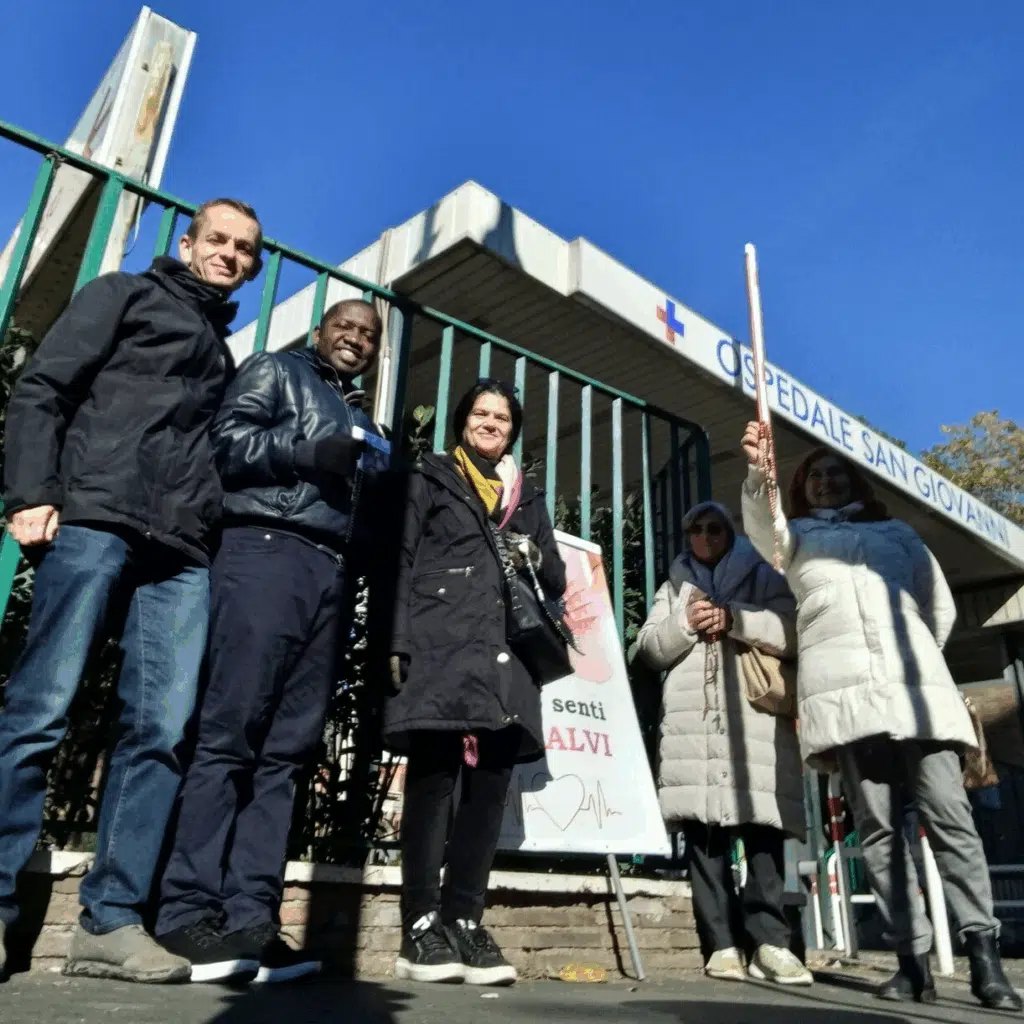
Many of the lives of the saints show us that the defense of dignity begins close to home — in our families, our schools, our workplaces, and our communities. We may not be called to martyrdom or heroic public witness (although some of us may be!), but we are all called to daily sacrifices of love.
Each of us can (and indeed, must!) become a saint.