Last week, moral theologian Charles Camosy published a column in the Washington Examiner under the disturbing title, “Infanticide is Back [1].”
Camosy was not being inflammatory, provocative, or hyperbolic. He was simply stating the facts. As he carefully lays out, in the United States, in 2026, it is routine for children to be born alive and then deliberately allowed to die, for the same reasons other children are killed before birth. And then, of course, there is the fact that very late-term abortions are legal in various states – a practice that is essentially indistinguishable from infanticide.
When Camosy says infanticide is “back,” he is referring to the fact that infanticide was the ordinary practice of the ancient world. Greece and Rome saw no moral difference between abortion and the exposure of a newborn (i.e., a child left outside to die) and used both as a form of population control, most often against the children of the poor and against children born with disabilities.
What ended the practice was not some new scientific discovery, or some flourishing of a new secular humanism. It was the arrival of Christ, and the ascendence of His followers: a people who insisted that even (or especially) the most helpless, “worthless” members of society are made in the image and likeness of God (Gen 1:26-27), and that the infant on the rubbish heap was somebody’s brother.
That conviction held for sixteen centuries. It is now collapsing.
Massachusetts Legalizes Abortion Until Birth
On Monday, August 10, Massachusetts Governor Maura Healey signed H.5595 [2]. This law struck out the last limits on abortion in the state after twenty-four weeks and left in their place the “professional judgment” of whichever doctor performs it.
In other words, with Healey’s signature, Massachusetts became the eleventh American jurisdiction with no gestational limit of any kind on abortion. An unborn child can be killed, for any reason, up to the point of birth.
Defenders of the bill insist that nobody performs abortions late in pregnancy without grave medical cause. This is, like so many pro-abortion talking points, pure propaganda.
Warren Hern of Boulder has been committing late-term abortions for decades. Unlike the smooth-talking pro-abortion activists and politicians who work valiantly to hide the brutal realities of abortion behind a sanitized veil of propaganda, he is perfectly blunt when confronted about his work.
Asked by the science writer Michael Shermer whether women come to him in the third trimester with no medical problem at all, who have simply changed their minds, and whether he performs those abortions, Hern answered simply [3]: “It happens all the time, of course.” When Shermer pressed him further, clarifying whether there was no medical problem in such cases, Hern responded, “The medical problem is that she’s pregnant!”
The brutal reality in states that allow abortion up to birth is that in one wing of the hospital, a premature child will receive the most cutting-edge health care available, with no expense spared, to save his life, while in another wing of the same hospital, a child that is much more developed, is deliberately left to die, even in cases when standard treatments could save his life.
In such cases, the only difference involved is the location of the child, i.e. inside or outside his mother’s womb, not anything about the child himself. It’s hard to see this as anything other than infanticide.
Texas Scrambles to Stop Infanticide Case
However, as Camosy notes, infanticide is also being practiced in cases when the child is not in his mother’s womb but already born.
On the exact same day, the Massachusetts law came into effect, in Texas, a lawyer for the State wrote a ten-page letter [4] to two Dallas hospitals, and to the physicians and nurses who would staff them that week, because a child was about to be born whose legal parents had said they would not let him be treated.
Last week [5] in this column, I told you about McKenna West, the Alaskan surrogate mother who refused to abort the child she was carrying when an ultrasound found he had hypoplastic left heart syndrome. She flew to Texas to give birth. Baby Gabriel was born on August 12.
The story was even darker than I realized last week. It turns out that not only did the intended parents (i.e. those who paid the surrogate to carry a baby for them) demand that the surrogate abort the child, they also made it clear that the hospital should not treat Baby Gabriel after he was born.
As the state’s letter explains:
The child has been diagnosed with hypoplastic left heart syndrome. His treating physicians have recommended the Norwood procedure, the first of the three staged operations that are the standard of care for that condition. The State understands that the intended parents have stated they will refuse consent to that operation, and that they may seek to move the child to California so that treatment can be withheld there.
In fact, the intended parents weren’t just going to “move” Baby Gabriel. They were going to have him loaded onto an air ambulance to California, at enormous expense…so that he would not be treated, and left to die.
The Texas memo walked the hospitals through why no physician could lawfully sign off on such a flight. Federal law permits transferring an unstable patient only when a doctor certifies that the benefits of treatment at the receiving facility outweigh the risks of the journey. Here, the State observed, a physician asked to write that certification “would have to record the risks of moving a ductal-dependent neonate by air and, opposite them, nothing.”
The next day the Texas court entered its order [8]. The judge found that the evidence “raises substantial question whether medically indicated, life-sustaining treatment will be provided to the child upon birth, and whether the child may be removed from this State before that question can be heard.” The court ruled that no one was to withhold, obstruct, or delay the child’s care.
Worrying Mindsets Among Medical Professionals
It would be comfortable to treat Gabriel’s parents as monsters and stop there. However, as Camosy notes, the kind of thinking they were following has become increasingly standard among the professionals who would have carried out their wishes.
Camosy points to a 2013 commentary in the Journal of Perinatology, by two neonatal ethicists, Annie Janvier and Mark Mercurio. In the article, titled “Saving vs creating [9],” they observed that when a newborn is at risk of a given level of disability, some clinicians consider it acceptable to withhold life-sustaining treatment and let him die, while an older infant with that same level of disability would never be considered a candidate for comfort care alone.
In each case, the child is identical, but for age. The disability is identical. What changes is whether the doctor understands himself to be “saving” a person who possesses a right to life and quality health care, or simply “creating” a disabled person.
Thinking like this is why federal regulation, drafted after the Baby Doe cases of the 1980s, has to spell out that infants with disabilities are to be treated “no less vigorously” than other infants, and has to exclude from the calculation, in so many words, “the negative effects an impaired child’s life may have on other persons, including parents, siblings, and society.”
Baby Gabriel was Nearly Left to Die
Gabriel did get his operation. But, the cost was steep.
It required a surrogate mother who was willing to lose her fee, absorb a lawsuit, and fly three thousand miles, to save his life. It required a state attorney general to intervene in a private custody suit. It required a district judge to enter emergency orders on a few hours’ notice. It required the federal Department of Health and Human Services to remind two major hospitals that disability law forbids withholding treatment because someone has judged a life to be of lesser value. It required reporters willing to expose what was going on.
Meanwhile, somewhere there is a child whose birth mother signed the same contract and kept her word to abort the child when the intended parents demanded it. And, all across the country, as Camosy notes, there are newborn babies who are being born with treatable conditions, like Gabriel’s, who are being left to die, because they do not meet somebody’s standard of life that is worthy of life.
As Camosy writes:
Some readers may remember the infamous interview [10] in which then-Virginia Gov. Ralph Northam, a former pediatric neurologist, was asked what happens in these situations. His ominous yet confident answer was that “the infant would be delivered, the infant would be kept comfortable, the infant would be resuscitated if that’s what the mother and the family desired. And then a discussion would ensue between the physicians and the mother.”
This was apparently so common that Northam was taken aback [11] by the massive backlash to his remarks.
Christianity Changed Culture in Ancient Rome
The thesis of Camosy’s article is exactly right. We have not invented a new ethics. We have gone back to an old one.
The pagans exposed the weak and the deformed and the inconvenient, and they did it without qualms, because they simply could not conceive of a worldview in which weakness was anything other than something to be eradicated.
Then Christ came into the world, as an infant born in a stable, to a poor carpenter. And he preached both the dignity of the poor, the weak, and the abandoned, and a practical ethic built around humility and service to the most needy. “Whatever you did for one of the least of these brothers and sisters of mine, you did for me” (Mt 25:40-45).
The pagans could never have thought up those famous words of St. Paul’s: “God chose the foolish things of the world to shame the wise; God chose the weak things of the world to shame the strong.” (1 Cor 1:27) This was a moral revolution, and it has resounded throughout the world since the time of Christ.
Camosy makes one final point in his column that is worth emphasizing. When Christianity gained influence in the Roman world, he notes, it did more than simply denounce the exposure of infants. Around the year 320, Constantine put two laws against child-killing into the Roman code. One of them directed money out of the imperial treasury to parents of children who might be at risk of abortion or infanticide.
Baby Gabriel’s surgeries will cost a great deal. So does raising a child with spina bifida, or Down syndrome, or a heart that has to be rebuilt in three stages. None of that cost licenses anyone to seek his death. But Constantine was on to something important when he recognized that it is not enough merely to condemn that which is evil. We must also build a culture of life – one that provides the practical structures and inducements to defend innocent life.
Every parish that supports a pregnancy center, every non-profit that has programs to cover medical costs for a family that chose life after a hard diagnosis, every Catholic who has adopted a child the world had written off, is doing exactly what the early Church did to pagan Rome. That is how a culture actually changes. Argument alone has never done it. We must back up our words with our hands.
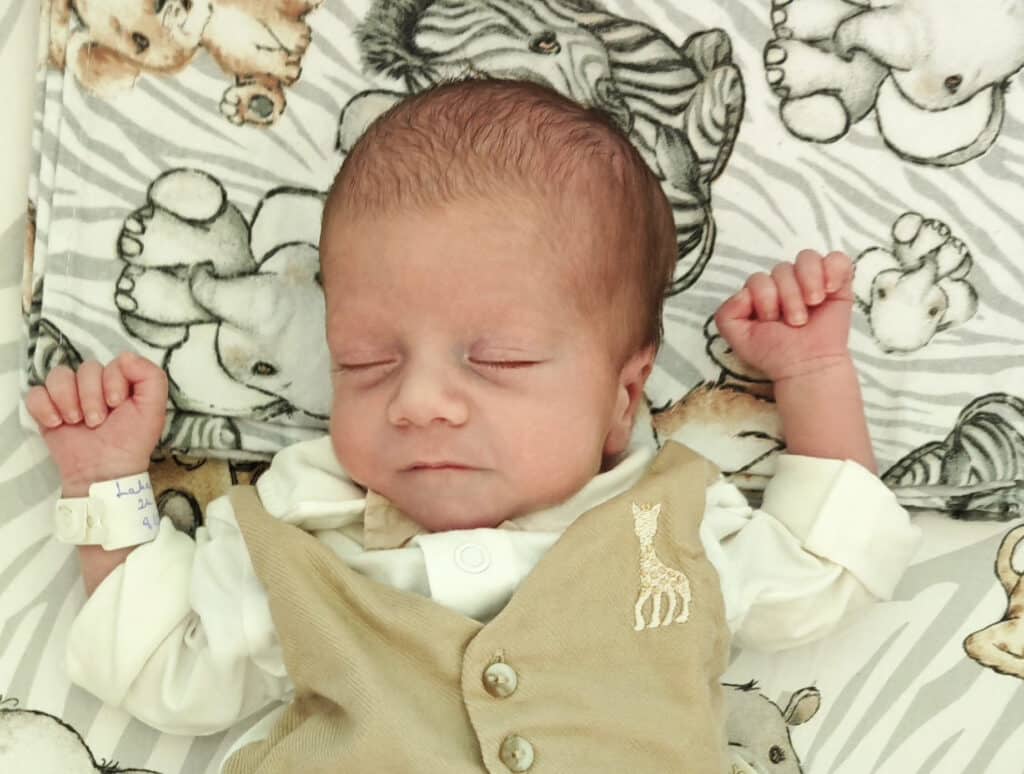
Let us pray this week for Gabriel, recovering from the first of three operations he was nearly not permitted to have. For McKenna West, who is fighting for a child the law does not yet call hers. And for the children who will be born this week to parents who have already decided against them, and who without intervention will be left to die, like the countless infants abandoned on hillsides in ancient Greece and Rome.
And let us pray for a conversion of our culture, back to Christ, so that we might once again witness the flourishing of a Culture of Life.