“Necessary emphasis should be placed on the ‘genius of women’, not only by considering great and famous women of the past or present, but also those ordinary women who reveal the gift of their womanhood by placing themselves at the service of others in their everyday lives. For in giving themselves to others each day women fulfil their deepest vocation. Perhaps more than men, women acknowledge the person, because they see persons with their hearts. They see them independently of various ideological or political systems. They see others in their greatness and limitations; they try to go out to them and help them.”
― Pope St. John Paul II, Letter to Women [1], no. 12
Gloria Steinem, the co-founder of Ms. magazine and for half a century the most famous feminist in the world, died on September 2 [2] at her home in New York City. She was 92.
The tributes poured in. Hillary Clinton said she “pushed open doors not just for herself, but for literally millions of women behind her.” Nancy Pelosi called her “a fearless trailblazer who transformed the fight for equality in America.” The president of Planned Parenthood, Alexis McGill Johnson, remembered her [3] as “a force who drew people to the cause of women’s freedom until her very last days.”
A statement from Steinem’s representatives said, “Gloria’s near-century on earth were years well-lived, and she continued working for equality until the very end.”
I read the obituaries with a heavy heart. I have prayed for her soul, as the Church prays for every soul. But I also read them with a growing sense that the most important thing about Gloria Steinem’s life was being passed over in a sentence or two, if it was mentioned at all.
Steinem, however, never passed over it. She put it front and center.
Steinem: Abortion “Gave me my Life”
In 2015, at the age of 81, Steinem published her memoir, My Life on the Road. It opens with a dedication to a doctor: Dr. John Sharpe of London [4], “who in 1957, a decade before physicians in England could legally perform an abortion for any reason other than the health of the woman, took the considerable risk of referring for an abortion a twenty-two-year-old American on her way to India.”
The 22-year-old, of course, was Steinem herself. The doctor, she wrote, asked two things of her. “First, you will not tell anyone my name. Second, you will do what you want to do with your life.”
“I’ve done the best I could with my life,” Steinem concluded. “This book is for you.”
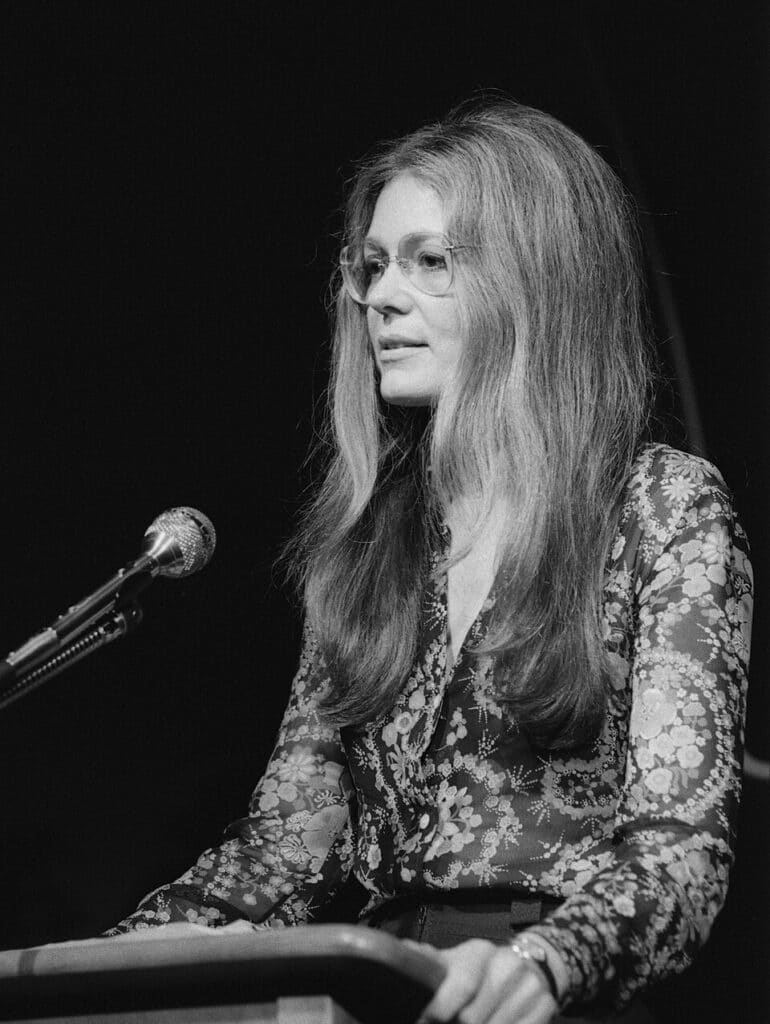

She expanded upon this theme in a TV interview the same year her book was released. Of her abortion she said: “It gave me my life. I mean, I wouldn’t have been able to live my life otherwise.” And in a 2011 interview [6] she described it as “the first time I had taken responsibility for my own life.” “I wasn’t going to let things happen to me,” she said. “I was going to direct my life, and therefore it felt positive.”
This month USA Today called the dedication [7] a “touching tribute.”
The founding act of the most celebrated life in modern feminism, by the account of the woman who lived it, was the death of her own child. Everything else came after it and, as she insisted to the end, depended on it.
In other words, the movement that promised women freedom told them, from the very beginning, what the price of that freedom would be. It would be their children.
Steinem’s Consistency
Steinem was, above all, consistent. For sixty years she said the same thing.
In 1972 the first issue of Ms. carried a petition headed “We Have Had Abortions,” signed by Steinem and dozens of prominent women, at a time when abortion was still illegal in most of the country. She co-founded Choice USA. She raised millions of dollars [6] for Planned Parenthood. She popularized the line, which she attributed to a Boston cab driver, that “if men could get pregnant, abortion would be a sacrament.”
Late in life she was still describing abortion [8] as “a profoundly moral decision.”
She was equally consistent in her dim view of motherhood. In an interview last year [9], asked whether she had any regrets about never having children, she answered: “No, no, absolutely not.” She was willing to be called the “big sister” of the women’s movement, she said, but never its “mom,” because “I’ve never been a mother.”
Where did this come from? Steinem told us that too, and it adds a note of tragic pathos to her story. Her own mother had abandoned a promising career in journalism and suffered from severe depression for most of Gloria’s childhood. Looking back, Steinem concluded [10] that if she herself had never been born, her mother “could have been born instead.” “I mourned her unlived life,” she wrote.
That is a staggering thing for any woman to say, let alone think. I have great compassion for the little girl who felt that her very existence was somehow a stumbling block to her mother. Astonishingly, however, the husband and the culture that had left her mother alone and unsupported escaped all blame. The blame fell on the child.
For Steinem, a woman could have a child, or she could have a life, and she could not have both. She was so consistent on this point that she was willing to apply it to her own life – portraying her very existence as a stumbling block to her mother.
She then spent her life telling millions of young women the same thing.
Pope St. Paul VI Saw It Coming
Steinem’s abortion took place in 1957, eleven years before Humanae Vitae [11]. The pill had not yet been approved. The sexual revolution was not yet in full swing. And yet when Pope St. Paul VI sat down to write about what would follow from the separation of sex from procreation, he described the world Steinem would spend her career building.
He warned first of “marital infidelity and a general lowering of moral standards.” He also warned that a man accustomed to contraception “may forget the reverence due to a woman” and come to treat her as “a mere instrument for the satisfaction of his own desires.” Finally, he foresaw governments taking the same power into their own hands, which is exactly what China did with its one-child policy eleven years later.
Every one of those predictions has come true. But there is a deeper point. Pope St. John Paul II made it in Evangelium Vitae [12]. Contraception and abortion, he wrote, are “fruits of the same tree.” In many cases they are practiced “under the pressure of real-life difficulties.” But very often, he continued, they are “rooted in a hedonistic mentality unwilling to accept responsibility in matters of sexuality, and they imply a self-centered concept of freedom, which regards procreation as an obstacle to personal fulfilment” (no. 13).
Procreation as an obstacle to personal fulfilment. That is Gloria Steinem’s position, stated with pin-perfect precision, decades before Steinem wrote her dedication.
Of course, as I have so often pointed out in this column, the “liberation” angle leaves a huge part of the story out. If we’ve learned anything these past 60 years, it’s that the sexual revolution freed men far more than it freed women. It relieved them of the consequences of their desires and handed the bill to women, who were now expected to be available, to be on the pill, and, when the pill failed, to “take responsibility” in a clinic.
Pope St. Paul VI warned this would happen. Steinem’s movement called it empowerment.
The Cost: Sixty-Three Million Lives
The cost of that empowerment can be counted, at least in part.
Between Roe v. Wade and the Dobbs decision in 2022, roughly 63 million children [13] were aborted in the United States. That is the number of Americans who were never allowed to have a life, so that others could “direct” theirs.
And what of the women who were promised so much? In 2025 the Institute for Family Studies surveyed American women [14] and found that married mothers were nearly twice as likely as unmarried, childless women to say they were “very happy.” The General Social Survey found the same thing [15] in 2022: forty percent of married women with children under 55 described themselves as very happy, against twenty-two percent of women who were neither married nor mothers.
Steinem promised those women happiness. The numbers say that the opposite happened.
Pope St. John Paul II’s Alternative “New Feminism”
None of this means the Church has nothing to say to women who wanted more than the world of 1957 offered them. She has a great deal to say. She simply refuses to say that the way forward runs through the death of a child.
Pope St. John Paul II called for what he named a “new feminism,” one “which rejects the temptation of imitating models of ‘male domination’, in order to acknowledge and affirm the true genius of women in every aspect of the life of society” (EV, no. 99). In Mulieris Dignitatem [16], seven years earlier, he had pointed out the precise error at the heart of Steinem’s project:
In the name of liberation from male “domination”, women must not appropriate to themselves male characteristics contrary to their own feminine “originality”. There is a well-founded fear that if they take this path, women will not “reach fulfilment” but instead will deform and lose what constitutes their essential richness. (no. 10)
Equality, in other words, does not mean sameness. When Adam first saw Eve, he did not see a rival or a lesser creature. He saw “bone of my bones and flesh of my flesh” (Gen 2:23), an equal in dignity and a partner in vocation. The Catechism of the Catholic Church [17] teaches that “in creating men ‘male and female,’ God gives man and woman an equal personal dignity” (no. 2334). It also teaches that each “should acknowledge and accept his sexual identity” (no. 2333), because the difference between them is a gift, ordered toward “the goods of marriage and the flourishing of family life.”
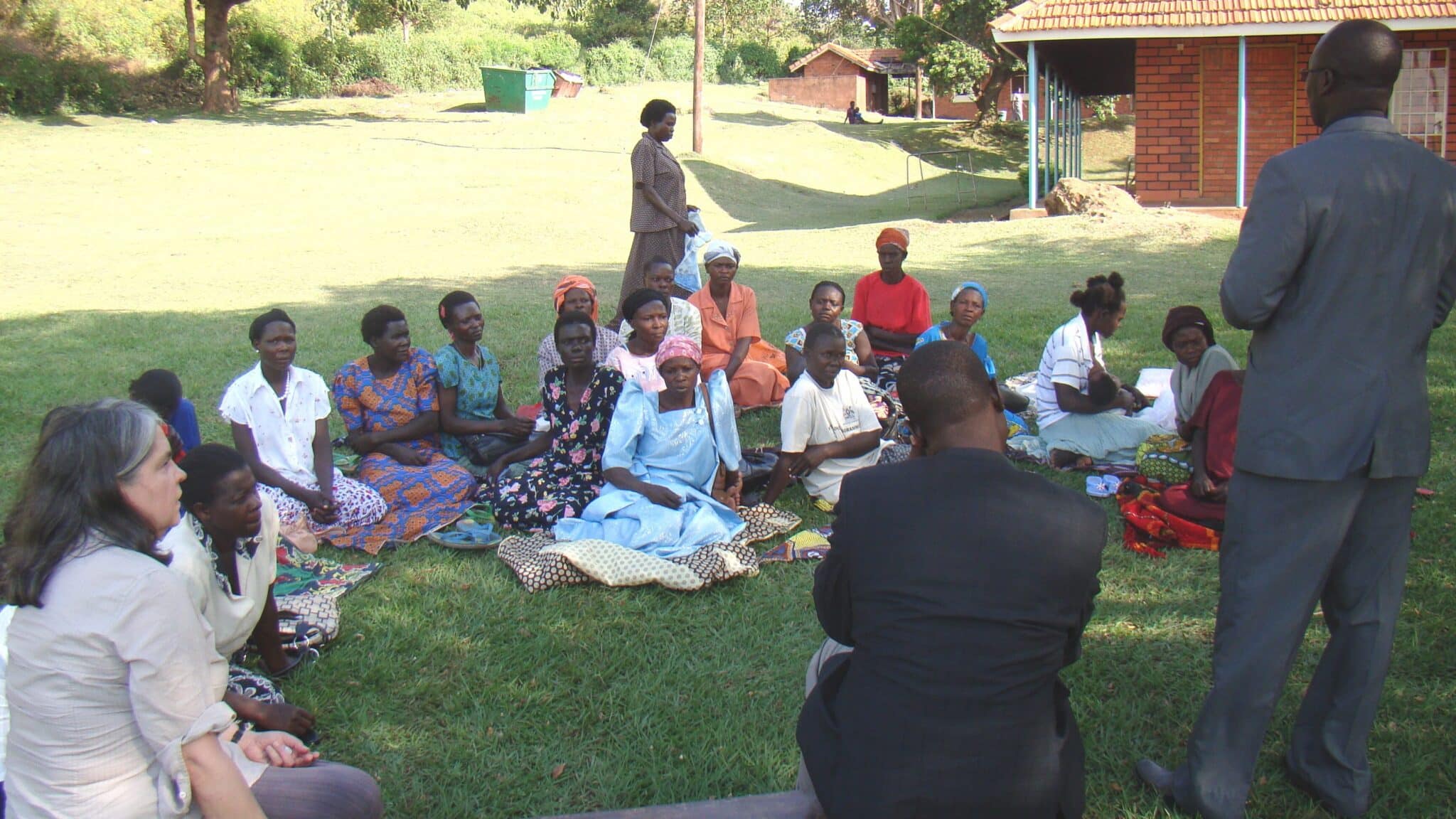
Steinem’s feminism measured a woman’s worth by how completely she could escape what is most distinctively hers. The Church’s “feminism,” if we may call it that, begins from the opposite conviction. “The moral and spiritual strength of a woman,” Pope St. John Paul II wrote, “is joined to her awareness that God entrusts the human being to her in a special way” (MD, no. 30).
A mother, Pope St. John Paul II wrote in Evangelium Vitae, “welcomes and carries in herself another human being, enabling it to grow inside her, giving it room, respecting it in its otherness.” From this, women “first learn and then teach others that human relations are authentic if they are open to accepting the other person” (no. 99).
Gloria Steinem’s Deadly Promise
Gloria Steinem kept her promise to Dr. Sharpe. She did what she wanted to do with her life. And she became one of the most effective evangelists the culture of death has ever had, precisely because she was sincere. She really believed that a woman had to choose between her child and herself. And she even applied it to her own existence.
To the millions of women who believed her, who aborted their own children, and who now carry the wound she never admitted to carrying, Pope St. John Paul II addressed some of the tenderest words in Evangelium Vitae: “The wound in your heart may not yet have healed. Certainly, what happened was and remains terribly wrong. But do not give in to discouragement and do not lose hope. … The Father of mercies is ready to give you his forgiveness and his peace” (no. 99). To that same Father, he added, “you can with sure hope entrust your child.”
Steinem’s life is now in God’s hands, and we commend her to his mercy. But the promise she made to women, that they must give up, sacrifice their children in order to have their lives, is one the Church will never make. There is another freedom, and another feminism. It begins with a mother’s yes to her child, to love, and it is the foundation of what Pope St. John Paul II called the civilization of love.