


Canada’s Tyranny on Freedom of Conscience for Religious Institutions

“The institutional conscience of a Catholic health care service is rooted in its identity as a ministry and formed by the authoritative teaching of the Church.”
― Ethical and Religious Directives for Catholic Health Care Services, 7th Edition
William Hume is a 79-year-old retired golfer from Edmonton, Alberta. In the summer of 2025, he was diagnosed with late-stage gastroesophageal cancer. He decided that he wanted to die through euthanasia, and was approved for Canada’s Medical Assistance in Dying (MAiD) program shortly after his diagnosis.
As his illness progressed, he was admitted to Grey Nuns Community Hospital, the only Edmonton hospital with an available bed. This hospital traces its roots to the Sisters of Charity (Grey Nuns) of Montreal, a Catholic religious order founded in 1737. The Grey Nuns have been providing healthcare to Edmontonians for over 130 years, always guided by strong Catholic ethics.
However, Hume and his family were outraged when they discovered that the Grey Nuns would not permit Hume to be killed by euthanasia in the hospital, and that he would have to be transferred to another hospital before MAiD could occur. He died on September 5, six hours before he was to be transferred for his scheduled euthanasia appointment.
It should be obvious that no grave injustice was committed against Hume. In his final days, he was cared for by the Grey Nuns Hospital staff according to their high standards of care. However, the family, with the help of the Canadian media, is now launching a crusade against the hospital, depicting the hospital’s actions as having victimized Hume.
A feature-length article in the CBC excoriates faith-based hospitals like the Grey Nuns Hospital that dare to decline participation in the killing of their patients. Hume’s daughter complained to the CBC, “My dad would be horrified to find out that he went to a faith-based place, and his final wishes were dictated by a religion that he didn’t even believe in.”
The CBC quotes Dr. Stefanie Green, who points positively to the situation in Quebec, where a recent law requires all palliative homes to allow patients to be killed onsite. “I do think we’ve seen that change. That’s a positive sign,” said Dr. Green, “but I think certainly when it comes to faith-based institutions, there’s a certain ideological value-based policy that’s in place that’s not likely to change.”
In other words, Catholic healthcare facilities should be forced to kill their patients. And if they won’t, they should simply get out of the business of providing compassionate health care altogether. Because they have an “ideological” opposition to kill their patients.
The Pattern of Coercion
Last week, I wrote about the persecution of Isadora Borges in Brazil for stating basic biological facts about sex. What links her case to Covenant Health’s ordeal (the Grey Nuns Community Hospital is operated by Covenant Health — a publicly funded, Catholic health-care provider in Alberta) is a common dynamic: once a society’s values shift in fundamental ways, no number of initial assurances that “your freedoms will be protected” is sufficient to prevent coercion.
We have seen this pattern repeat across the Western world: religious adoption agencies forced to close rather than adopt children out to same-sex couples, doctors and nurses disciplined for declining to participate in abortions, and pharmacists compelled to dispense abortifacient contraceptives against their consciences. And now, in Canada, Catholic hospitals that have served their communities for over a century are told they must either facilitate the killing of their patients or face the accusation that they are “imposing their values” on others.
The coercion goes deeper than legal compulsion. In Canada, where the culture of death is far advanced, the state and public institutions demand compliance with its new moral order and actively demonize those who dissent from it.
The logic is always the same. First, a new “right” is established. Then, those who object are told their concerns will be respected: conscience protections will be maintained, opt-outs will be allowed. But soon the very existence of dissent is reframed as an intolerable imposition on those exercising the new right. And in time (often extremely rapidly) the protections erode, the opt-outs narrow, and the dissenters are compelled to choose between their livelihoods and their convictions.
A Culture that Kills on Demand
What makes the campaign against Catholic hospitals especially troubling is that it comes at the very moment Canada’s MAiD program is drawing international horror for its extremism.
Recently, an official report by the Chief Coroner of Ontario’s MAiD Death Review Committee revealed that in 2023, 65 people in Ontario had their lives ended on the same day they requested euthanasia. A further 154 died the next day.
Among them was a woman identified as “Mrs. B,” a woman in her 80s who initially withdrew her euthanasia request, citing “personal and religious values and beliefs,” and asked instead for hospice palliative care. After being denied hospice care, her spouse requested another assessment. She was approved and died the same day, despite the first assessor’s documented concerns about possible coercion due to “caregiver burnout.” The committee itself acknowledged that “poor quality end-of-life care potentially impacted the request for a brief MAiD provision timeline.”
Think about that. The country that is hounding Catholic hospitals for declining to kill patients, is simultaneously killing patients on the same day they ask to die – in some cases, patients who had previously declined euthanasia and whose consent is questionable.
Canada removed its ten-day waiting period in 2021. There are no specific criteria governing same-day deaths. And the government is preparing to expand MAiD eligibility still further: a planned 2027 expansion would allow euthanasia for those whose sole condition is mental illness. Private Member’s Bill C-218, which would block that expansion, is expected to come to a vote in early March 2026.
There are hundreds of stories like Mrs. B’s…that we know of. Some of them are even more horrifying. Veterans actively pushed towards euthanasia, the impoverished offered death rather than meaningful assistance, and on and on.
This is not a healthcare system with a minor procedural disagreement about hospital transfers. This is a culture that has embraced killing as a medical solution and now treats the refusal to kill as the scandal.
And yet, for some reason the CBC reserves its outrage for a well-run Catholic hospital system that is offering real healthcare, because it sticks to its Catholic roots.
A Grave Violation of the Law of God
The Church has been unwavering in its teaching that euthanasia is intrinsically evil and can have no role in authentic healthcare. Pope St. John Paul II, in Evangelium vitae, wrote:
In harmony with the Magisterium of my Predecessors and in communion with the Bishops of the Catholic Church, I confirm that euthanasia is a grave violation of the law of God, since it is the deliberate and morally unacceptable killing of a human person (no. 65).
Pope St. John Paul went on to label euthanasia “a disturbing perversion of mercy,” and insisted that “true compassion leads to sharing another’s pain; it does not kill the person whose suffering we cannot bear” (no. 66).
This teaching is at the core of Catholic anthropology and ethics. A Catholic hospital that participated in euthanasia would not merely be violating a rule, it would be cooperating in a grave moral evil.
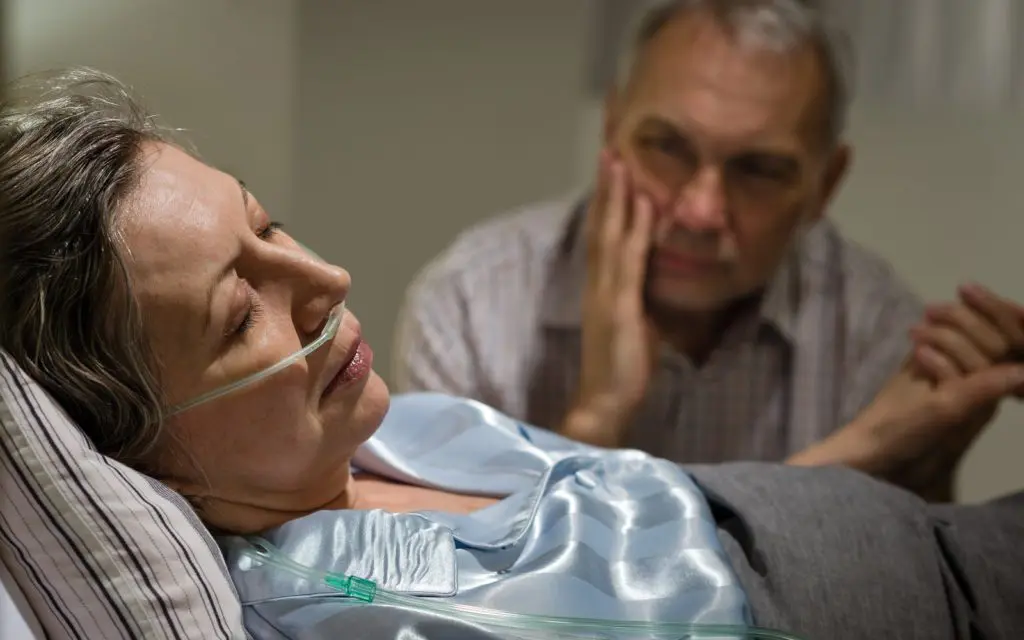
Thus, the demand that Covenant Health and institutions like it facilitate MAiD is therefore not a request for “neutrality.” It is a demand that the Church become complicit in what it recognizes as the deliberate killing of innocent human beings. No Catholic institution can comply with such a demand and remain Catholic in anything but name.
The Canadian bishops have been at the forefront of opposition to Canada’s extreme euthanasia regime.
In a 2023 statement, the full body of bishops declared “unanimously and unequivocally” that euthanasia and assisted suicide are morally unacceptable within any health organization with a Catholic identity, calling them affronts to human dignity and violations of natural and divine law.
The bishops have directly intervened in the legislative debate. On February 4, 2026, the Canadian Conference of Catholic Bishops’ (CCCB) Permanent Council, issued a statement strongly supporting Private Member’s Bill C-218, introduced by Langley MP Tamara Jansen, which would prevent persons whose sole medical condition is mental illness from accessing MAiD.
The bishops declared that “human life is a gift that must be protected and valued at every stage and in every circumstance,” cited research showing that mental illness is not necessarily irremediable and that most patients experience significant improvement over time. They called on the government to permit a free conscience vote on the bill rather than enforcing party discipline.
The Inviolability of Conscience
The Catholic Church teaches that conscience is sacred. The Catechism of the Catholic Church describes conscience as “a judgment of reason whereby the human person recognizes the moral quality of a concrete act” (CCC, no. 1778) and insists that it bears witness “to the authority of truth in reference to the supreme Good to which the human person is drawn” (CCC, no. 1777).
The Catechism continues:
Man has the right to act in conscience and in freedom so as personally to make moral decisions. He must not be forced to act contrary to his conscience. Nor must he be prevented from acting according to his conscience, especially in religious matters (CCC, no. 1782).
It’s notable, however, that this is not merely a claim defended by the Catholic Church. It is a principle recognized in the Universal Declaration of Human Rights and in Canada’s own Charter of Rights and Freedoms. Yet it is precisely this right that is now under systematic assault.
The Canadian bishops have attempted to strongly oppose this encroachment of state tyranny on the freedom of conscience of religious believers. In their Pastoral Letter on Freedom of Conscience and Religion, the Permanent Council of the Canadian Conference of Catholic Bishops (CCCB) warned that when religious freedom “is threatened, all other rights are weakened and society suffers.”
A Call to Faithful Witness
The Canadian bishops’ pastoral letter on conscience rights concludes with a bold call for Christians to stand true to their consciences.
“The Church’s vitality has often been nourished by persecution,” they wrote.
Our era is no exception. Those who refuse to cooperate with an unjust law or practice that would oblige them to act against their conscience – and are not given the right to conscientious objection or accorded respectful accommodation – must be prepared to suffer the consequences that result from fidelity to Christ. They deserve the effective solidarity and prayerful support of their religious communities.
They continued,
The bold ‘Be not afraid!’ of [Saint] John Paul II continues to ring out, giving us courage to follow our conscience in every circumstance, regardless of the cost. … Let us cast out any fear that would prevent us from answering the urgent voice of the Holy Spirit always to act according to the dictates of an informed conscience.
Let us pray for the medical professionals, the hospital administrators, and the religious communities who are being pressured to compromise what they know to be true. And let us resolve to stand with them, in solidarity and in truth, against a culture that has confused killing with compassion and conformity with freedom.
Human Life International
As president of Human Life International, Fr. Boquet is a leading expert on the international pro-life and family movement, having journeyed to nearly 90 countries on pro-life missions over the last decade. Father Boquet works with pro-life and family leaders in 116 counties that partner with HLI to proclaim and advance the Gospel of Life. Read his full bio here.


Is the EU Undermining Pro-Life Laws? The Rise of Abortion Tourism