


Marriage and the Family: God’s Remedy to the Culture of Death
“The Family Remains the Privileged Locus of a Culture of Life”
Christmas is, I think it is fair to say, one of the most beautiful of all the liturgical celebrations of the year.
Whether or not it is the greatest is sometimes a cause for debate. Many a theologian will argue that Easter trumps Christmas. The Resurrection, after all, is the source of all our hope. In rising from the dead, Christ overcame death, and restored mankind to union with God.
However, though both solemnities are steeped in rich theological meaning and connection, there is simply no denying the great beauty of Christmas. In part, this is because of the remarkable liturgical and cultural effluences that have grown up about Christmas: the midnight Mass, the gorgeous Christmas carols, the sacred art, the Christmas trees and decorations, the gifts and giving, the camaraderie, and the hundred other traditions that lend such weight and warmth to the feast.
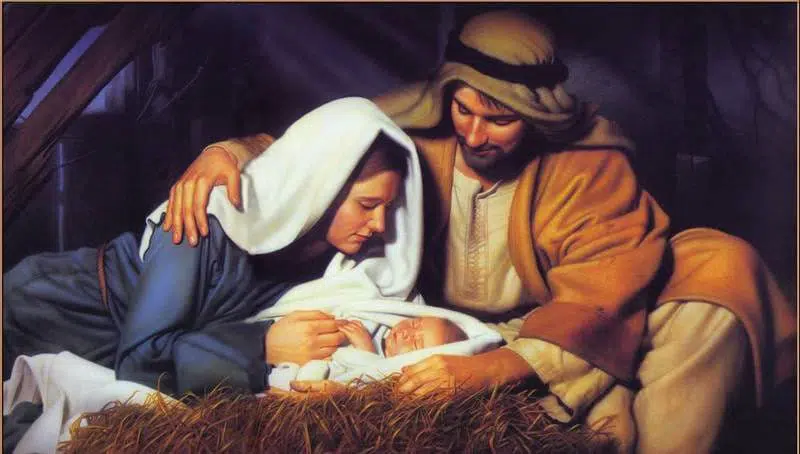
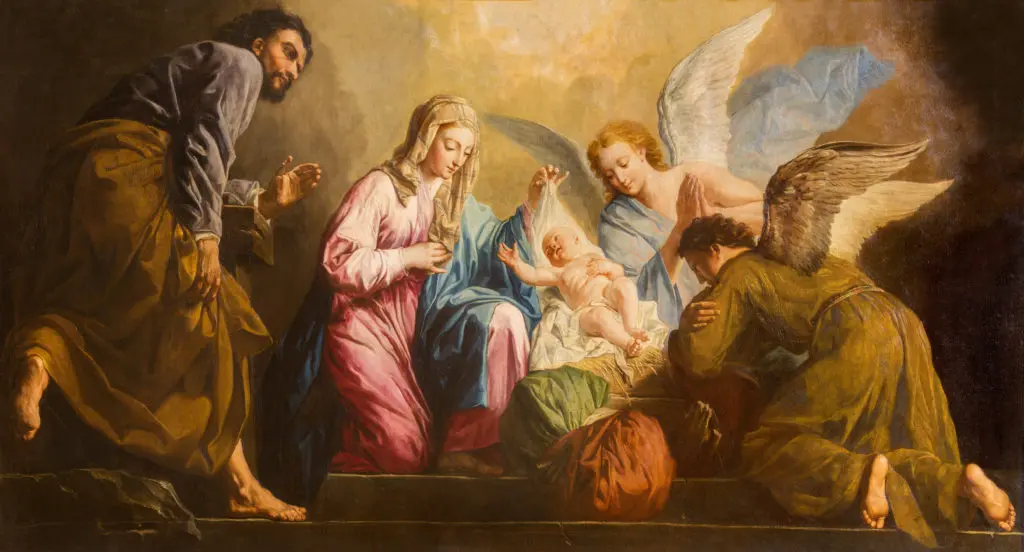
And, in part, it is simply because of the intrinsic beauty of the iconography of Christmas: above all, the image of the Holy Family gathered in the stable at Bethlehem.
Easter is magnificent—central to Christian faith, symbolizing victory over death and new life in Christ. The Resurrection represents the height of the supernatural at work in our world. And as such, there is an “uncanniness” to Easter.
On the other hand, everyone comes from a family. And everyone can identify with the love, warmth, and intimacy that is captured in the scene at Bethlehem. And everyone naturally feels a yearning to participate in that warmth.
Though Christ in the manger is the incarnate God, yet His entrance into this world is so normal. It is, so understated, that it feels as if we can place ourselves in the scene, as a quiet bystander looking in on something that is simultaneously the most ordinary thing in the world, and the most extraordinary event in all of human history.
It is the inner logic of the scene at Bethlehem, of familial love, that has generated all those thousands of traditions emphasizing family, love, giving, beauty, and fellowship.
The Holy Family: Not a Whitewashed Icon
For me, as for many other pro-family activists, the scene at Bethlehem is so powerful, because it points to the fundamental simplicity of the solution to so many evils of the culture of death, i.e., the family, united in love.
Just as, in becoming human, Christ sanctified and elevated human nature (the topic of the Spirit & Life column from two weeks ago), so too, in entering into a family, Christ sanctified and elevated the human family, in all of its complexity.
Although above I have emphasized the great beauty of the scene in the stable of Bethlehem, we must take care not to whitewash or sanitize that image.
It is important to remember that the Holy Family at Bethlehem was not comfortable. We tend to associate a sense of “coziness” with the scene. While there was, no doubt, great warmth of love in the stable, and a remarkably deep union of persons in love, there is no reason to believe that the Holy Family were “warm,” in the physical sense.
Joseph and Mary had just travelled an immense distance, with Mary on a donkey, and Joseph walking on foot. Mary must have been extremely uncomfortable, as any nine-months pregnant woman would be under those circumstances. And Joseph must have been foot-sore and exhausted.
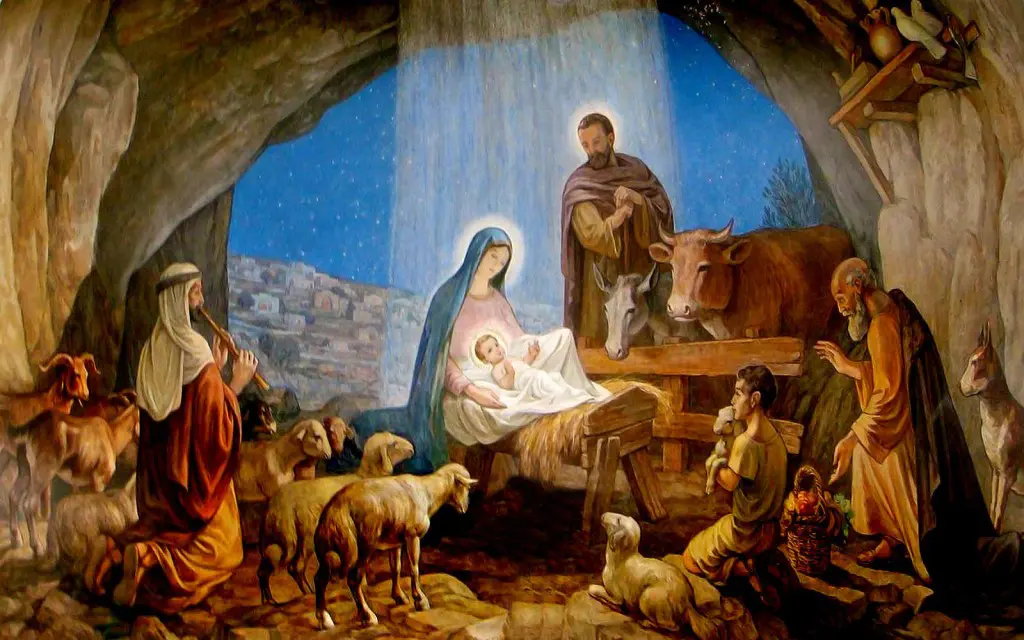
And then, how hard it must have been for Joseph to reach Bethlehem and not be able to find reasonable accommodations for his pregnant wife, at such a vulnerable time. It is easy to imagine that Joseph felt temptations towards shame in the hours before and after the birth of Jesus: shame that he could not provide better for Mary. How hard it must have been for him, as it would have been for any father, to see the Christ placed in a manger, the rough feeding trough of filthy animals. How hard it must have been not to be able to provide doctors, midwives, delicate foods, or warm blankets.
What I am trying to emphasize is that it was within extremely imperfect circumstances that the Holy Family were united in such deep love. It is not because they were coddled that the scene at Bethlehem is so beautiful. It is rather precisely because of the ruggedness, discomfort, pain, and hardship, that the scene at Bethlehem is so powerful.
Joseph, Mary, and Christ knew cold, hardship, and discomfort. And yet, one can imagine the delicacy and tenderness with which Mary comforted Joseph and assured him that the stable was all she needed, and that she was happy. And one can imagine the relief when Joseph heard Mary’s comforting words, and how her love enabled him to put down his guard, and to open his heart to the newborn child, undisturbed by his regrets or fears.
This is the great power of family. It is not a perfect refuge from the trials of the world. At times, it can even be the source of great trials, as when a marriage suffers misunderstandings, or when one or more of the spouses or children are sick or suffering.
And yet, where else but in the family can humans be challenged to and learn to grow in the kind of self-sacrificial, deep love that transforms the world from the inside out?
The Value of the Family
The Church insists that marriage and the family are not arbitrary human inventions, subject to endless redefinition. They are rooted in creation itself.
As the Catechism of the Catholic Church teaches, the family is “a communion of persons, a sign and image of the communion of the Father and the Son in the Holy Spirit” (no. 2205). The conjugal union of man and woman is thus both profoundly human and deeply theological: it reflects God’s own life of self-giving love.
Pope Leo XIV recently summarized this vision: “[M]arriage is not an ideal but the measure of true love between a man and a woman: a love that is total, faithful and fruitful. This love makes you one flesh and enables you, in the image of God, to bestow the gift of life.”
From this conjugal union arises the family, which the Church consistently calls “the first and vital cell of society.” As Pope St. John Paul II explained in Familiaris consortio, the family has “vital and organic links with society, since it is its foundation and nourishes it continually through its role of service to life” (no. 42).
Society does not create the family; rather, the family generates society by forming persons capable of participation, responsibility, and solidarity.
The Culture of Death and the Breakdown of the Family
When marriage and family life are weakened, distorted, or rejected, the consequences ripple outward.
The rise of divorce normalizes impermanence and undermines trust. Contraception severs love from life, turning fertility into a problem to be managed rather than a gift to be welcomed. Abortion thrives when sexuality becomes a pastime, rather than an expression of marital love, so that the child becomes an intruder or interloper, rather than the natural and welcome fruit of love. And euthanasia thrives when the sick and elderly lack strong familial networks, which can carry them through sickness, aging and death by protecting them with the kind of constant, personalized love that no institution can provide.
Underlying all these evils of the culture of death is a shared logic: the person is valued only insofar as he or she is wanted, productive, autonomous, or convenient. The family, by contrast, teaches a radically different lesson. Within the family, one is loved before one can achieve anything at all, as Christ was loved by Joseph and Mary while a completely helpless infant. Children, the elderly, the sick, and the weak all belong, not because of what they contribute, but because of who they are.
This is why Catholic Social Teaching insists that the person is not only sacred, but also social. Human dignity is not realized in isolation, but in communion. The family is the first place where this truth is experienced concretely and daily.
The Family as the School of Social Virtues
Catholic Social Teaching regularly emphasizes the family’s irreplaceable role in building “a society truly human.”
As Pope Francis wrote in Fratelli tutti, “Families are the first place where the values of love and fraternity, togetherness and sharing, concern and care for others are lived out and handed on” (no. 114). It is within the family that children learn patience, forgiveness, fidelity, sacrifice, and responsibility—virtues without which no society can endure.
Scripture repeatedly presents the family as the privileged place of moral and spiritual formation, where love and faithfulness to the Lord are learned and handed on from one generation to the next.
A society that neglects or undermines families should not be surprised when civic trust collapses, loneliness increases, and social fragmentation accelerate. The chaos of modern society is not accidental; it reflects the breakdown of the family at its roots.
The Holy Family and the Choice Between Trust and Fear
In a recent Angelus reflection on the Holy Family’s flight into Egypt, Pope Leo XIV offered a powerful contrast between two ways of organizing society. On the one hand stands Herod, driven by fear, clinging to power, and willing to destroy innocent life to preserve his own security. On the other stands the Holy Family, marked by obedience, trust in God, and openness to life even amid danger.
“The world always has its ‘Herods,’” Pope Leo observed, “its myths of success at any cost, of unscrupulous power, of empty and superficial well-being.” Societies shaped by these myths, he warned, “pay the price in the form of loneliness, despair, divisions, and conflicts.”
However, he added:
It is precisely this hardness of heart…that further highlights the value of the presence and mission of the Holy Family. In the despotic and greedy world represented by the tyrant, it is the birthplace and cradle of the only possible answer of salvation, that of God who, in total gratuitousness, gives himself to men without reserve and without pretension.
Every Christian family, suggested Pope Leo, participates within this same mission. “As we contemplate this mystery with wonder and gratitude, we think of our families and the light they can bring to the society in which we live,” he said.
Let us not allow these mirages to suffocate the flame of love in Christian families. On the contrary, in our families, we should cherish the values of the Gospel: prayer, frequent reception of the sacraments – especially Confession and Communion – healthy affections, sincere dialogue, fidelity, and the simple and beautiful concreteness of everyday words and gestures. This will make them a light of hope for the places in which we live; a school of love and an instrument of salvation in God’s hands.
The Family as the Foundation of Law, Economics, and Politics
If the family is the fundamental unit of society, then this truth must shape how we organize our laws, economies, and political systems. Catholic Social Teaching affirms that people have both a right and a duty to participate in society in pursuit of the common good. But such participation is learned first within the family.
In bioethics, the family teaches us to protect life at every stage, resisting utilitarian calculations that reduce persons to functions. In economics, it reminds us that labor exists for the person and the family, not the other way around. Pope Leo XIV recently emphasized that families must be at the center of the labor system, warning against economic models that exhaust workers and fracture family life.
In law and public policy, recognizing the family as the “first and vital cell of society” means supporting marriage, protecting parental rights, enabling work-family balance, and resisting policies that treat individuals as interchangeable units rather than human persons possessing an intrinsic dignity.
As Gaudium et spes teaches, “A society built on a family scale is the best guarantee against drifting off course into individualism or collectivism, because within the family the person is always at the center of attention as an end and never as a means” (no. 47 & Catechism of the Catholic Church, no. 2210).
Reintroducing the Family to a Deaf and Blind Society
How, then, do we reintroduce marriage and family to a society that has grown deaf and blind to the truth?
Not primarily through coercion or nostalgia, but through witness. Healthy families—joyful, faithful, open to life—are themselves an argument. They reveal, by their very existence, that love is possible, fidelity is fruitful, and sacrifice leads to joy.
The Church’s task is to proclaim, defend, and support this vision, trusting that the truth about the human person resonates even when obscured. In a culture of death, the family remains the privileged locus of a Culture of Life.
Marriage and the family are not remnants of a bygone era. They are God’s enduring remedy for a wounded world—where human dignity is learned, protected, and passed on, one generation at a time.
This is one of the many lessons to be learned by contemplating on the scene at Bethlehem.
Human Life International

As president of Human Life International, Fr. Boquet is a leading expert on the international pro-life and family movement, having journeyed to nearly 90 countries on pro-life missions over the last decade. Father Boquet works with pro-life and family leaders in 116 counties that partner with HLI to proclaim and advance the Gospel of Life. Read his full bio here.

Today, reading this beautiful message, the deplorable effects that the life insurance industry have imposed on basic respect and regard for human life and basic human rights surfaced in my thoughts.
Saint Gertrude please pray for us.