
The New Eugenics and the Disappearance of Down Syndrome
A few weeks ago, YouTube “influencers” Jesse Ridgway and his wife Ashley announced to their four million subscribers that they were expecting their first child, due in the fall. They filmed a gender reveal. They posted ultrasound photos. In an earlier video, Jesse had told his audience that he was ready for whatever came. “I signed on to be a parent, come what may,” he said.
Then the prenatal screening came back with markers for Trisomy 21, i.e. Down syndrome. An amniocentesis confirmed the diagnosis. Jesse filmed that moment, too. As Ashley cried, he looked into the camera and told his followers they had discussed “terminating the pregnancy.”
So much for “come what may.”
On June 3, Jesse announced on X that they had aborted their son at twenty-one weeks.
“The choice was not made lightly,” he wrote. “I know some of you may be very disappointed to hear this news. We are devastated. This has been extremely traumatic for both of us, especially Ashley.”
Twenty-one weeks. At that age, a preborn child can feel pain, suck his thumb, hear his mother’s voice, and stretch his limbs. Last year, a preemie born at twenty-one weeks in Iowa survived.
Public Abortion and Public Backlash
In explaining their decision, Jesse Ridgway called Down syndrome “objectively sh**ty from a health perspective” and said it “isn’t a ‘blessing.’” He cited a statistic that up to 90 percent of women in similar situations abort. He closed by saying he and Ashley were “excited to try again in the future and hopefully have a better outcome.”
The post announcing the abortion has been viewed more than 24 million times. The response was, as you might expect, quite polarized and passionate.
In a follow-up post the next day, Jesse called the condemnations he received “disturbing” and evidence of “the depravity of people online.” He said he was confused as to why aborting a baby with Down syndrome was even newsworthy since it is “the most common outcome for Trisomy 21.” He described himself and Ashley as two people “grieving the loss of their unborn child.”
Except, of course, they did not “lose” their child. They chose to have him killed. And they did not make a “deeply personal decision” in private: they documented every moment of their son’s brief existence for four million subscribers. Everything was public except the gruesome details of his death.
Why People With Down Syndrome Are Vanishing
As I wrote last year, people with Down syndrome are quietly disappearing across the developed world. Not because of disease or natural decline, but because they are being killed before birth at staggering rates.
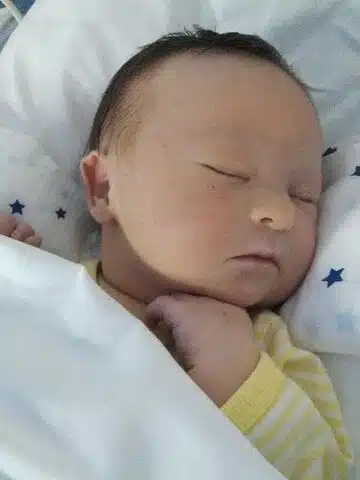
In the United States, an estimated 67 percent of preborn children who receive a definitive prenatal diagnosis of Down syndrome are aborted. In England, the figure is approximately 87 percent. In Denmark, only 18 children with the condition were born in a recent year.
In Iceland, the abortion rate for children diagnosed with Down syndrome is effectively 100%. As the head of the Prenatal Diagnosis Unit at Landspitali University Hospital explained to CBS, when the occasional child with Down’s is born in Iceland, it’s not because the parents chose to give birth, but because, “Some of them were low risk in our screening test, so we didn’t find them in our screening.”
As Jonathon Van Maren writes over at First Things: “In other words: we missed them.”
Eugenics with a White Lab Coat
There is a word for the systematic elimination of an entire category of human beings deemed unworthy of life. The word is eugenics.
The old eugenics was a state-run program of forced sterilizations and racial hygiene. It was discredited after its most notorious practitioner, Adolf Hitler, demonstrated its logical endpoint. What is happening today, we are told, is different, because it is based on choice.
In 2009, Pope Benedict XVI, speaking to the Pontifical Academy for Life, warned against the rise of precisely this kind of thinking. In contrast to the old eugenics, which targeted people by race or group, this “new eugenics,” he said, “tends to privilege the capacities for work, efficiency, perfection and physical beauty to the detriment of other dimensions of existence that are not held to be valuable.”
That is exactly what we are witnessing.
The language has shifted from “racial hygiene” to “quality of life,” from “unfit” to “incompatible with life,” from government mandate to personal autonomy (i.e., the parents’ “right to choose”).
But the end is the same: an entire class of human beings is being marked for destruction before they can draw their first breath. The old eugenics used coercion. The new eugenics uses a subtler instrument: the expectation that responsible parents will make the “right” choice when confronted with an adverse prenatal diagnosis.
Jesse Ridgway himself pointed to the high abortion rate as confirming their decision: because most people do it, it must be the reasonable thing to do. This is the logic of the herd dressed up as the logic of reason.
Pope St. John Paul II identified this dynamic in Evangelium Vitae:
A person who, because of illness, handicap or, more simply, just by existing, compromises the well-being or life-style of those who are more favored tends to be looked upon as an enemy to be resisted or eliminated. In this way a kind of ‘conspiracy against life’ is unleashed (no. 12).
After a Prenatal Diagnosis, Parents Face Immense Pressure to Kill
Jesse is not wrong that there is enormous pressure on parents in his position. Many parents who discover that their preborn child may have Down syndrome report that they are not simply offered the option of abortion but are actively pressured to accept it. The message from health care providers is often unsubtle: “You wouldn’t want your baby to suffer, would you?”
The expectation runs so deep that it shapes even how parents announce a pregnancy. In Denmark, as Sarah Zhang reported in The Atlantic, one couple told friends and family they had waited to share the news of their pregnancy “because if it had Down syndrome, we would have had an abortion.”
Their daughter was born with Down syndrome anyway. They called the head of Denmark’s Down Syndrome Association, afraid that their loved ones would now think they did not love their child. That is what the new eugenics does to families: it makes the acceptance of one’s own child feel like something that requires an apology.
Consider the case of Leanne Constable, a British mother who was told at 16 weeks that there was a 95 percent chance her preborn child would have Down syndrome. She recounted to Wales Online that on the very same phone call delivering the diagnosis, the medical team suggested termination.
“I felt awful,” she said. The pressure continued throughout her pregnancy. Obstetricians repeatedly asked why she hadn’t had an amniocentesis. The information she received overwhelmingly emphasized abortion rather than care. Eventually, she had to have it written in her medical notes: “Do not discuss termination.”
Her son, Parker, was born with Down syndrome. The experience, she says, has been nothing like the nightmare the doctors described. She set up an Instagram page to show other parents what life with a child with Down’s actually looks like.
“I wanted to show parents a real life of a person with Down’s and the joy and love,” she said. “I am not saying there are not hard days, but you can have that with any child. Having one less chromosome does not mean he is worth less.”
People with Down Syndrome Are the Happiest People on Earth
In the days following Jesse and Ashley Ridgway’s announcement, hundreds of families of children with Down syndrome flooded social media with photographs, videos, and testimonials. They showed their children laughing, playing, working, graduating, loving.
A famous peer-reviewed study published in the American Journal of Medical Genetics found that nearly 99 percent of adults with Down syndrome report being happy with their lives. Ninety-seven percent say they like who they are. Ninety-nine percent feel loved by their families.
Research consistently shows that families of children with Down syndrome report higher levels of resilience, empathy, and cohesion. Researchers have called this the “Down syndrome advantage.”
Jesse Ridgway called Down syndrome “objectively sh**ty.” However, the people who actually live with it report being among the happiest human beings on the planet – certainly much happier than the people who are so quick to suggest “termination” to parents expecting a child with Down’s.
One of those people, an Icelandic woman with Down syndrome, was once asked what she would tell the world about people like her. Her answer was devastating: “They only see Down syndrome. They don’t see me.”
Every Child a Gift
For those of us who are immersed in the battle to protect life, and who have met those born with Down syndrome, the attitude of the Ridgways is almost inconceivable. As Van Maren writes:
Influencers like Ridgway produce “deeply personal” content in order to provoke a public reaction and earn clicks and income. Ridgway ensured that millions of people knew that his son existed, and that millions were informed when he did not. Because these children are usually destroyed silently, he did not expect a backlash. That it came is a grim silver lining to this story. That the destruction of a child with Down syndrome has provoked such a broadly negative reaction is not only good, but deeply necessary. It indicates that our public immune system with regard to eugenics is not yet dead—but like people with Down syndrome, it may soon be completely wiped out.
At the same time, Jesse and Ashley Ridgway’s shock at the backlash demonstrates just how steeped they are in a culture that has been telling them, for decades, that children are commodities to be chosen or discarded according to parental preference. In a way, it’s easy to pity them. Somehow, they could scarcely even conceive of the possibility that people would not approve of their decision.
They live immersed in a world where “choice” has been elevated to the supreme moral principle, where the autonomous will of the individual trumps every other consideration, including the right of an innocent child to live. And they were immersed in messages highlighting the supposed nightmare they would face if they brought their child into the world. They were told by doctors, counselors, friends, and the accumulated weight of cultural expectation that what they did was responsible, compassionate, even brave.
A Call to Defend the Most Vulnerable
Over and against this culture of death, the Catholic Church has insisted upon the dignity of every human life. The Catechism teaches that “human life must be respected and protected absolutely from the moment of conception” (no. 2270). Every human being, regardless of ability or disability, possesses infinite dignity because he or she is created in the image of God. That dignity is a fact written into the structure of creation itself, and it does not bend to efficiency calculations, lifestyle preferences, or utilitarian reasoning of any kind.
In the face of this horrific “conspiracy against life,” it is critical that we support organizations like the National Down Syndrome Society that serve children and adults with Down syndrome.
And we must support those families who flooded social media with their joy and their love, in the hope that they may continue to be a light in a world grown too accustomed to darkness. Let us pray, too, for Jesse and Ashley Ridgway, that they may one day come to understand what their decision cost them and become advocates for life. And let us pray for the soul of their son, who was never given a name, who will never be held by his mother or father, but who was known to God from the moment of his conception, and who possesses, in the eyes of his Creator, a dignity that no human judgment can take away.
Human Life International
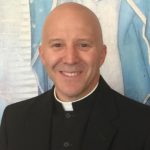
As president of Human Life International, Fr. Boquet is a leading expert on the international pro-life and family movement, having journeyed to nearly 90 countries on pro-life missions over the last decade. Father Boquet works with pro-life and family leaders in 116 counties that partner with HLI to proclaim and advance the Gospel of Life. Read his full bio here.
This article was extremely enlightening, as well as horrifying. Please, yes provide the ebook that explains what cosmetics have fetal cells, as well as any companies that support abortion.
Thank you for a truly timely article on this subject. This couple – like so many of these “influencers” – are clueless. They need our prayers.
Down Syndrome people are so wonderful and loving – walking demonstrations of how God loves us!
Thank you especially for the link with the National Down Syndrome Society, which I didn’t know existed. I will definitely support them!